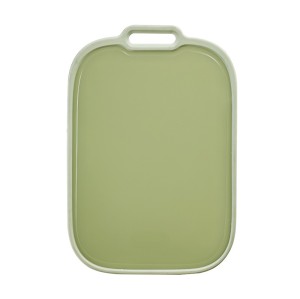
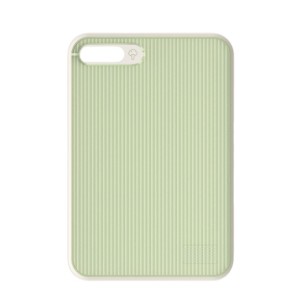
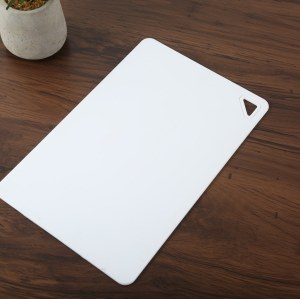
Wholesale Kitchen Double-Sided Antibacterial Plastic Cutting Board 11" X 15" With Non-slip Feet and Juice Groove
- Price
- US $2.43
- Model
- 6639 Cutting Board
- MOQ
- 200 piece
Item specifics
- Material
- TPE frame with wheat-straw PP cutting face
- Size
- 40 × 30 × 1 cm
- Thickness
- 10 mm
- Colour
- Green frame, pale speckled cutting face
- Faces
- One grooved face, one flat face
- Juice groove
- Full perimeter, moulded
- Handle
- Elongated through-hole, top edge
- Grinding panel
- Oval dotted panel
- Underside
- Embossed non-slip pattern
- Dishwasher
- Yes
- Certification
- FDA, LFGB
- Reference price
- USD 2.43/piece FOB, subject to quantity and packaging
- Port
- Shanghai or Ningbo
Review
Description
40 × 30 × 1 cm · model 6639 · double-sided with juice groove Forty by thirty centimetres is not a bigger version of a small board. It is the size at which a board stops being a surface for chopped food and becomes a surface that whole ingredients can lie on: a whole salmon, a whole chicken, half a watermelon. This model is built for that job, and the juice groove around the edge is there because whole ingredients arrive wet. It is the largest board in this family, and the only one with a full perimeter groove on one face. Both facts matter to a buyer, because they decide which kitchens the board belongs in and which it does not. Most boards are bought for chopped vegetables, and for that job anything above 30 cm is wasted material. The case for this size starts with the ingredient that will not fit on a smaller board: A standard domestic worktop is about 60 cm deep. A 40 cm board leaves 20 cm in front of it, which is enough to work and not enough to be comfortable — worth knowing before specifying this size for a small kitchen. In a commercial prep area, 40 × 30 is unremarkable and correct. The groove is a channel moulded into the cutting face, running inside the rim and just outside the working area. Its job is not to store liquid; it is to interrupt it. Liquid that would otherwise run straight off the edge and across the counter hits the channel and stops. A groove of this depth will hold the liquid from a roast resting, a tomato, or a few fillets. It will not hold half a watermelon. When the volume exceeds the channel, the overflow goes over the rim like it would on any board — so the honest way to present the feature is as a delay, not a container. That distinction is worth making in the listing, because a customer who expects a reservoir will be disappointed, and a customer who expects a channel will not. The board is reversible, and the two faces are not mirror images. One carries the groove and the grinding panel. The other is flat across its whole width, which is the face to use when food has to leave the board in one movement: sliding diced chicken into a pan, or tipping chopped herbs into a bowl. A groove gets in the way of a sliding action; a flat face does not. That gives the board a natural division of labour rather than a marketing one. Wet, whole and raw on the grooved face; dry, chopped and ready-to-cook on the flat face. It also doubles the working life before the surface shows enough knife marks to be worth replacing. Look closely at the cutting face in the close-up above and the surface is covered in small raised dots. They are there to stop the ingredient sliding while it is being cut, which matters most on a wet, smooth surface like a tomato skin or a piece of fish. They are also the reason the underside needs its own grip. The dots hold the food; an embossed pattern on the reverse holds the board. The two are separate mouldings doing separate jobs, and neither is a rubber foot that can peel off in a dishwasher. A 40 × 30 cm board is manageable when dry and awkward when wet, particularly full of trimmings. The elongated hole at the top edge takes a hand, not just a hook, which means the board can be carried flat and one-handed to the sink instead of being scraped across the counter. This is the size where buyers most often ask for a change, and the most common request is a narrower board for a specific worktop. Any change to the outline means a new tool, so the first conversation should establish whether 40 × 30 works as it stands. If it does, colour and logo are quick changes and can be settled afterwards. Logo placement is best on the flat face. Putting a printed logo inside the grooved face means it sits in the wettest part of the board and wears fastest. Reference price is FOB and excludes packaging, printing and freight. Colour combination, logo method and carton configuration all move the final number — send the specification and a quote follows. Enough for a resting roast, a few fillets or a tomato — not enough for a watermelon. It works as a channel that interrupts flow rather than a reservoir, and it should be described that way to end customers. It is 10 mm, which is right for slicing, dicing and breaking down fish and poultry. It is not a chopping block and should not be used with a cleaver and a mallet. Yes. The panel is part of the mould, so removing it is a tooling decision rather than an option on an existing tool. It has to be agreed before the tool is cut. A 40 × 30 cm board fits most domestic machines on the lower rack at an angle, and the board is dishwasher safe. In commercial machines, check the rack dimensions against the board before ordering a large quantity. It is compounded into the polymer, not coated onto it, so washing does not remove it. It also does not make the board self-cleaning — it still has to be washed after raw meat. It depends on the colour combination and packaging format. Send the configuration and a specific minimum will be quoted against it, along with sample lead time. Send the size tolerance, colour combination and packaging format. A quotation with sample timing comes back the same way. OEM and ODM welcome · FOB Shanghai or Ningbo · T/T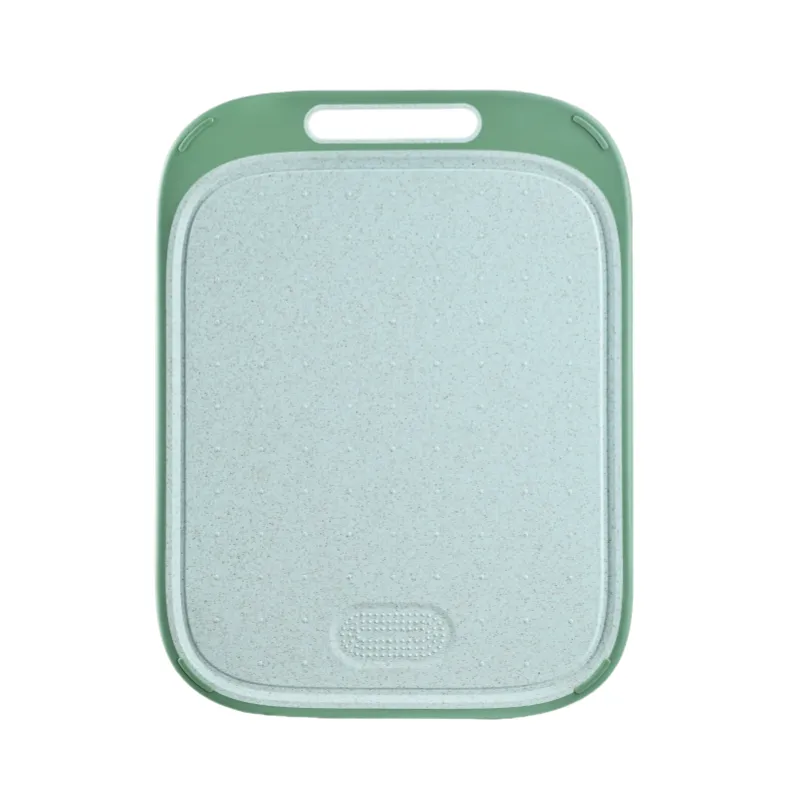
40 × 30 cm Is Sized for Whole Ingredients
What the Juice Groove Actually Does
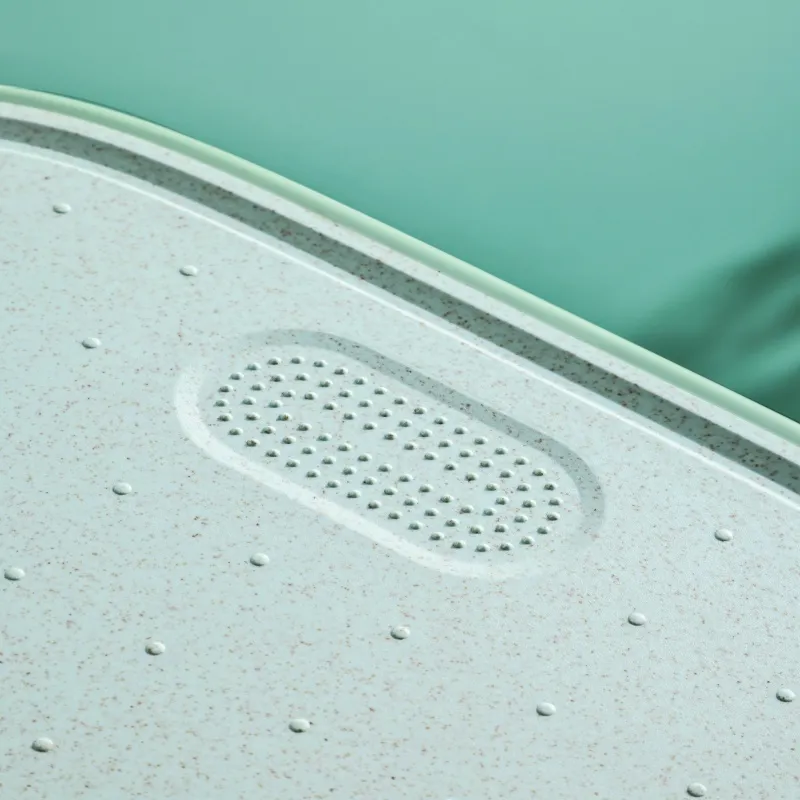
Its capacity has a limit, and buyers should hear it
Two Faces, Two Different Jobs
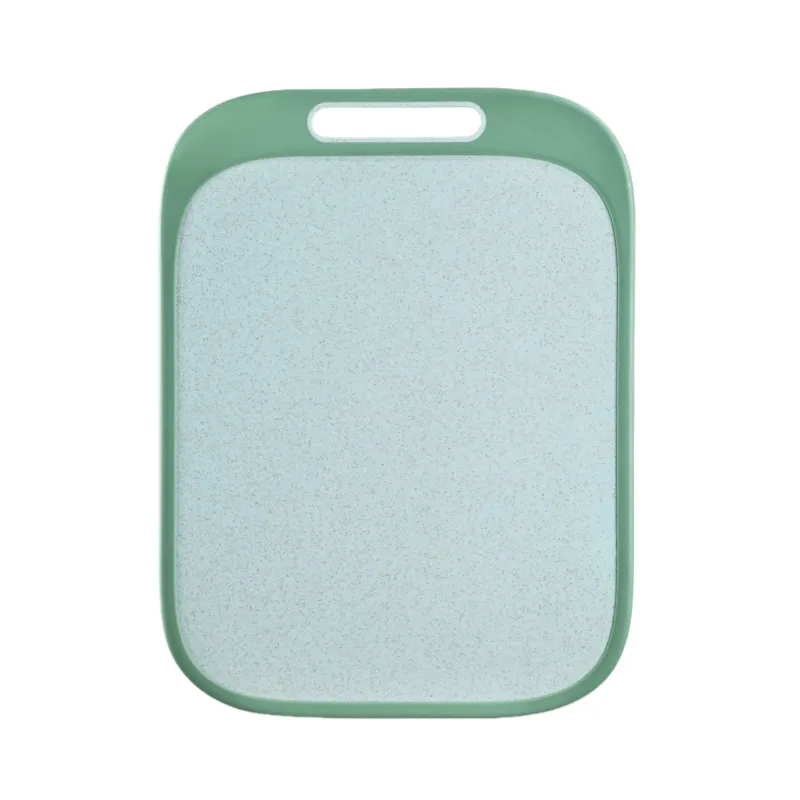
The Dots on the Surface Are Not Decoration
The Handle Hole Earns Its Place at This Size
Specifications
Model 6639 Size 40 × 30 × 1 cm (approx. 15.7 × 11.8 in) Thickness 10 mm Cutting face Polypropylene with wheat-straw fibre Frame TPE, moulded to the face Colour Green frame, pale speckled cutting face Faces One grooved face, one flat face Juice groove Full perimeter, moulded Grinding panel Oval, dotted, on the grooved face Handle Elongated through-hole, top edge Underside grip Embossed non-slip pattern Dishwasher Yes Certification FDA, LFGB Reference price USD 2.43 / piece FOB, subject to quantity and packaging Port Shanghai or Ningbo Payment T/T Who This Board Suits
Right for
Wrong for
Ordering and Customisation
Frequently Asked Questions
How much liquid does the groove hold?
Is the board thick enough to chop on?
Can the grinding panel be left off?
Will the board fit a standard dishwasher?
Does the antibacterial additive survive dishwashing?
What is the minimum order quantity?
Working on a large-board programme?