


Wholesale Faux Marble Plastic Cutting Board Set-Ideal for Distributors Retailers & Resellers
- Price
- US $1.62-1.65
- Model
- 6650
- MOQ
- 1000 piece
Item specifics
- Material
- Polypropylene with moulded TPE end caps
- Sizes
- 25 × 15 × 0.5 cm / 30 × 20 × 0.55 cm / 35 × 24.5 × 0.6 cm
- Section
- 5 mm / 5.5 mm / 6 mm
- Colour
- Black speckled face with red end caps
- Shape
- Rounded rectangle
- Handle
- None
- Dishwasher
- Yes
- Certification
- FDA, LFGB
- Port
- Shanghai or Ningbo
Review
Description
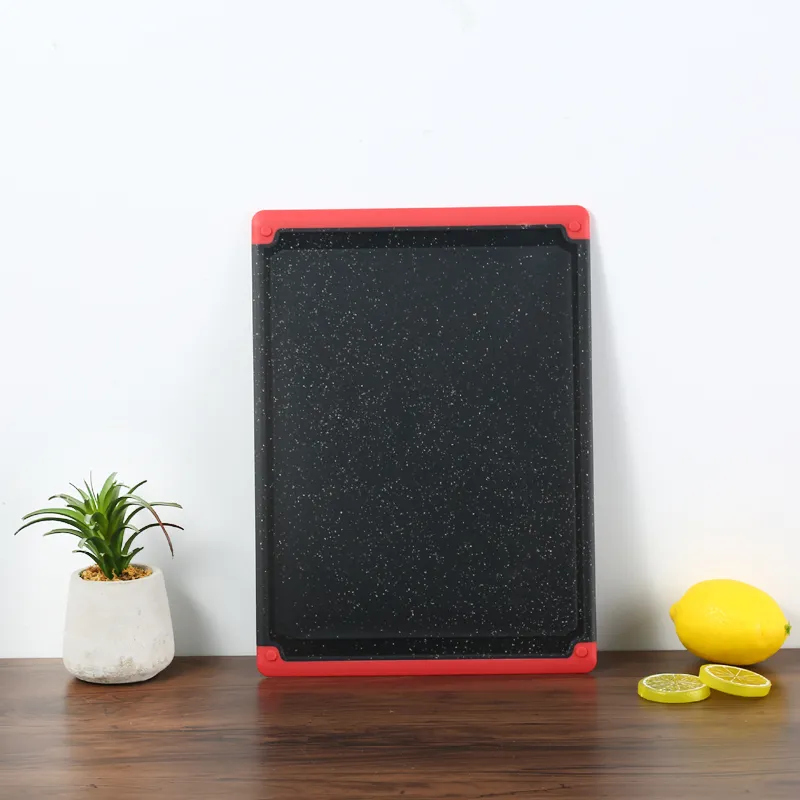
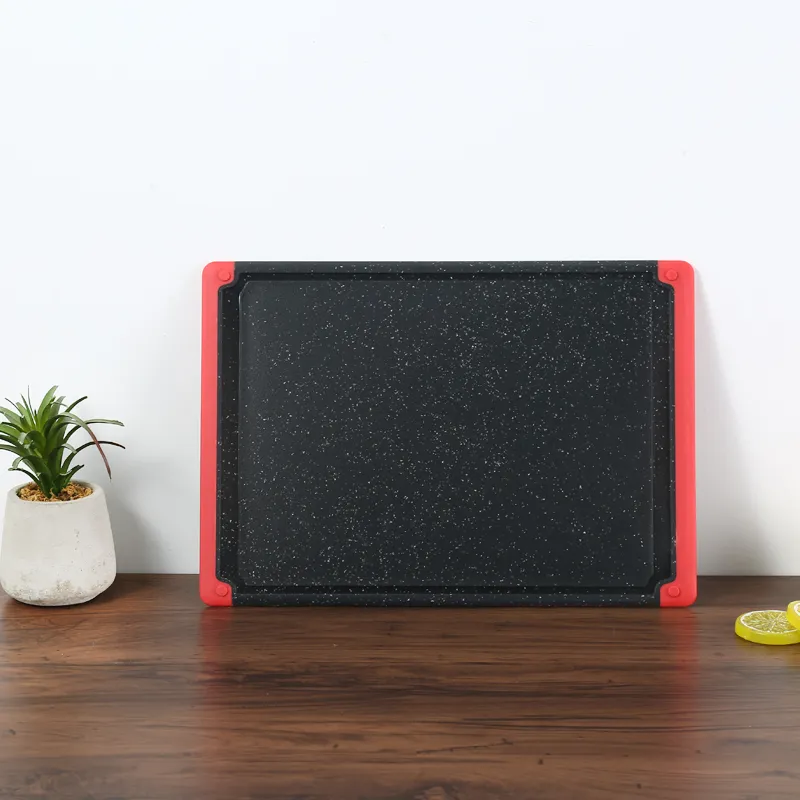
25 / 30 / 35 cm · model 6650 · black face, red end caps Red moulded ends cap the two short sides of this board. They are the only colour on it, and they are the reason to look at this model rather than the twelve other speckled boards in the same size range. Everything else here — the near-black face, the 5 to 6 mm section, the rounded corners — is deliberately plain. The strip is a separate moulded edge, not a painted line. It runs the full width of both short ends and finishes in a small round pad at each corner, leaving the two long sides bare. That detail matters when you are buying a board that has to be identified from across a kitchen rather than read up close on a shelf. Colour coding a kitchen normally means buying a set of boards in five or six solid colours. That works, but it also means every board in the kitchen is red, green, blue, yellow or white, and none of them looks like anything. A dark board with one coloured end does the same identification job and leaves the face neutral. It also avoids a problem that solid colour boards run into: the darker the colour, the less the board shows knife scars, staining from turmeric or beetroot, and the grey haze that builds up on a plastic surface after a year of daily washing. A near-black face stays presentable far longer than a red or green one, and the red ends carry the coding. The strip stands slightly proud of the cutting face. It is a moulded edge, so it does not peel, and there is no adhesive line for water to get behind. It gives the hand something to grip when the board is picked up by its ends, and it replaces a hard plastic corner with a softer-looking one. What it is not: this is not a liquid-tight tray. There is no deep channel cut into the face, and a running pool of meat juice will still reach the counter. If catching liquid is the requirement, a board with a moulded juice groove is the right product, not this one. The three sizes share one outline, so the end caps read identically at 25 cm, 30 cm and 35 cm. That consistency is what makes a multi-size order look like a family on shelf rather than three unrelated boards. The board is offered at 25 × 15 cm, 30 × 20 cm and 35 × 24.5 cm, with sections of 5 mm, 5.5 mm and 6 mm respectively. Those are prep boards, not chopping blocks. The progression is small enough that the three sit in one retail fixture without any of them looking like the odd one out. The smallest size is a garnish and fruit board. The middle size is the one that sells in a two-pack to a household that wants a board for bread and one for vegetables. The largest is the closest this model gets to a general-purpose board, and at 6 mm it is still thin enough to tuck behind a tap or hang from a hook by its corner. A 5 to 6 mm board flexes. On a flat worktop that is fine and even useful, because the board follows the surface instead of rocking on a high spot. Over a sink, or held across two supports with nothing under the middle, it will bow under a heavy load. Buyers who expect a rigid board at 35 cm should be looking at a 10 mm model; this is a different product for a different job. Thin boards sell into three places that thicker boards struggle with. Apartment kitchens where storage is a slot behind a tap. Food trucks and market stalls, where the board has to be carried in and out daily and weight matters. And catering setups that replace boards on a schedule, where a thin board at a low unit price is the point. They also suit a specific retail format: the flat, shrink-wrapped board that hangs from a peg on a card. A 6 mm board packs flat, ships cheap in a carton, and hangs straight. The strip colour is the cheapest thing to change, because it does not touch the cutting face and it does not touch the outline. A buyer who wants green, blue or yellow edges on the same black face can have it without new tooling, which makes this a practical board for a private-label colour programme. Changing the face colour is a bigger step, and changing the outline means new tooling. The sensible order of decisions is: confirm size and strip colour first, settle the face second, and leave packaging until last. Prices are FOB and exclude packaging, printing and freight. Final cost depends on size mix, strip colour and carton configuration — send the mix and a quotation follows. Only the ends. The cutting face is black with a fine speckle, and the red strip runs across the two short sides and finishes in a round pad at each corner. The two long sides are black. No. It is moulded onto the board rather than glued or pushed on, so there is no joint for water to work into and nothing to lose in the dishwasher. Not in normal use, because the strip sits outside the working area. Someone cutting right up to the very edge will eventually score it, and the mark will show more on a light strip than on a dark one. Yes. The strip colour changes without new tooling, so green, blue, yellow or a custom match are all practical for a private-label order. For vegetables, fruit, bread and cooked food, yes. For bone-in meat or heavy cleaver work, no — a board this thin will flex and the knife will find the worktop underneath. It depends on which size mix and which carton configuration you choose. Send the size split and the packing requirement, and the carton count comes back with the quotation. Send the size mix, the strip colour and the packaging format. A quotation and a sample schedule follow. OEM and ODM welcome · FOB Shanghai or Ningbo · T/T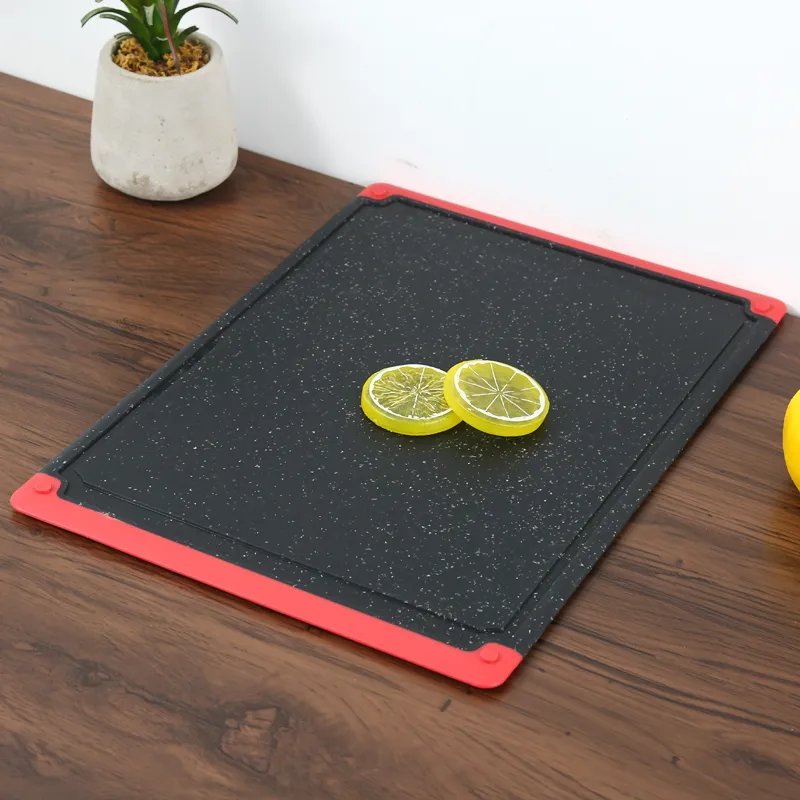
A Colour Band Is Cheaper Than a Colour Board
What the strip is and is not
Three Sizes, One Outline
Reading the thickness honestly
Where a Board This Thin Belongs
Specifications
Model 6650 Sizes 25 × 15 × 0.5 cm · 30 × 20 × 0.55 cm · 35 × 24.5 × 0.6 cm Section 5 mm / 5.5 mm / 6 mm Face Polypropylene, black with a fine speckle Edge Moulded coloured strip, both long sides Outline Rounded rectangle, no handle hole Colour Black face with red strip; other combinations on request Dishwasher Yes Certification FDA, LFGB Port Shanghai or Ningbo Payment T/T Who This Board Suits
Right for
Wrong for
Ordering and Customisation
Frequently Asked Questions
Is the whole board red or only the ends?
Does the red strip come off?
Will a knife cut into the coloured end?
Can the edge be a different colour?
Is 5 mm thick enough for daily cooking?
How many pieces fit in a carton?
Want the end caps in your own colour?


