


Wholesale High Quality Kitchen Artificial Marble Plastic Cutting Board Set
- Price
- US $3
- Model
- 6615
- MOQ
- 1 piece
Item specifics
- Material
- Polypropylene face with a moulded TPE rim
- Sizes
- 25 × 15 × 0.7 cm / 33 × 20 × 0.7 cm / 40 × 24.5 × 0.75 cm
- Section
- 7 mm / 7 mm / 7.5 mm
- Colour
- Black marble effect with a contrasting rim
- Groove
- Full perimeter on one face
- Second face
- Plain and flat
- Handle
- Oval cut-out in the top edge
- Set
- Three boards, nestable
- Dishwasher
- Yes
- Certification
- FDA, LFGB
- Port
- Shanghai or Ningbo
Review
Description
25 / 33 / 40 cm · model 6615 · black marble effect, juice groove There is a shallow channel cut around the edge of this board, just inside the outline. It runs the full way round without a break, and it is the reason the largest board in this set can hold a resting steak, a pile of sliced tomatoes or a whole fish without the liquid reaching the worktop. The face is a black marble effect — a dark base with pale veining drawn through it and a fine speckle underneath. It is a moulded surface, not a laminate, so the pattern is part of the board rather than a layer on top of it. The set steps through 25, 33 and 40 cm, and all three carry the same groove and the same oval handle cut-out. A juice groove is easy to describe and hard to get right. Cut it too shallow and the liquid runs over it. Cut it too close to the edge and the wall left outside the channel is too thin to be rigid. On this board the channel sits about a centimetre in from the edge, which leaves a rim wide enough to carry the board with food on it and deep enough to hold the run-off from a rested piece of meat. The practical limit is worth stating. A groove holds a few tablespoons per side. It is not a tray and it will not hold a whole carved chicken’s worth of juice. What it does is stop the small steady run-off that otherwise reaches the counter during carving. The groove is on one face. The other side is flat and plain, which gives a second working surface: groove down for meat and wet prep, plain face up for bread, vegetables and anything that does not want to sit in a channel. The oval cut-out at the top edge is the handle for both. Turn the board groove-down only on a clean, flat worktop. A recessed underside on a slatted or uneven surface will rock, and a rocking board is how knives slip. Knife marks on plastic show as a pale scuff, because the material underneath is the same colour but the surface has been scratched and now scatters light. On a light board those marks build up into a grey haze within a year of daily use. On a near-black board they read as a sheen and stay much less visible. Staining works the same way. Turmeric, beetroot, paprika and tomato all leave pigment that a plastic surface absorbs slowly. Against a dark ground those tints are far less obvious than they are on cream or white. The trade-off is that a dark board shows flour, salt and crumbs more clearly. That is a smaller problem in a kitchen, because those wipe off. The three boards run at 7 mm on the two smaller sizes and 7.5 mm on the 40 cm one. That is thick enough to stay flat in normal use and thin enough to store in a drawer slot. It is not a chopping block: a cleaver driven through a bone will find the worktop, and the groove edge is the weakest line on the board. For slicing, dicing, carving and general prep, including a whole fish on the 40 cm board, the section is fine. Buyers who need impact resistance should be looking at a 12 mm or thicker model. The marble effect is produced at the moulding step, so the pattern is consistent from board to board but the base colour can be shifted: a dark grey, a graphite or a brown-black are all achievable without new tooling. The rim colour is the cheapest change of all and is often used to give one set a private-label identity. Set composition is flexible. A three-piece set is the standard configuration, but two-piece and single-size orders are supplied when the volume supports it. Packaging is the main cost variable. Prices are FOB and exclude packaging, printing and freight. Send the size mix and the packing format and a set quotation follows. Moulded. The effect is produced in the polymer during moulding, so it runs through the board rather than sitting on the surface as a film. It does not peel or lift. Yes, the channel is continuous around the perimeter on one face. It stops short of the handle cut-out, which is the only interruption in the outline. Yes. One face has the groove and the other is plain. The plain face is the better choice for bread and dry prep, and the grooved face for meat and wet ingredients. It shows them far less than a white or cream board, because a scratch on a dark surface scatters less light. The board will still mark over time, as any plastic board does. For carving, yes. The section is stiff enough at 40 cm for a knife to work against. For chopping through bone, no — that needs a thicker block. Yes. All three share one black marble effect and one rim colour, which is what makes the set read as a family when stacked. Send the size mix, the base colour and the rim shade. A quotation and sample schedule follow. OEM and ODM welcome · FOB Shanghai or Ningbo · T/T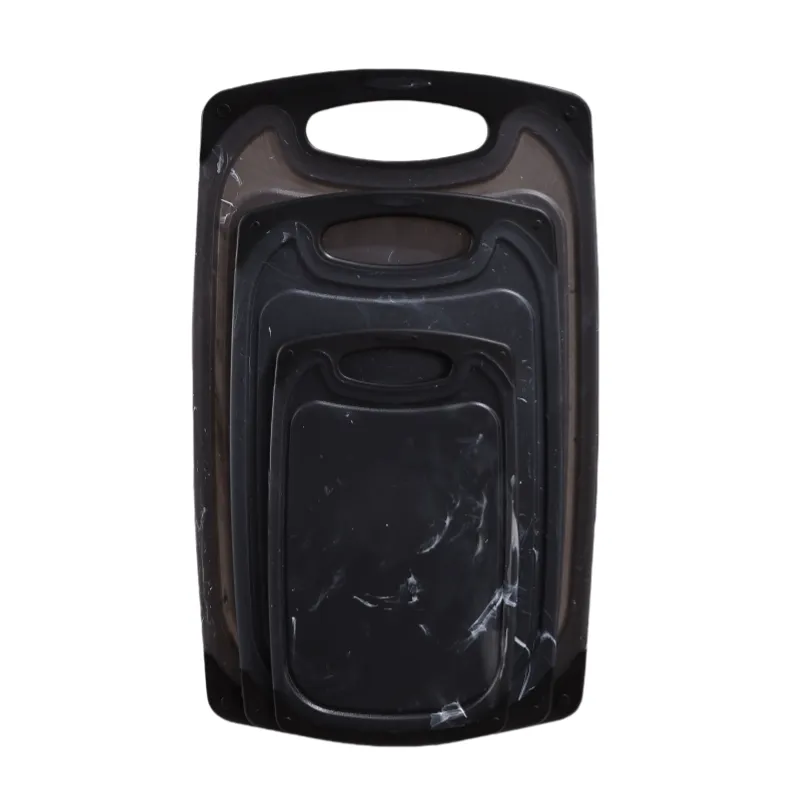
The Groove Is the Feature Worth Paying For
Two working faces
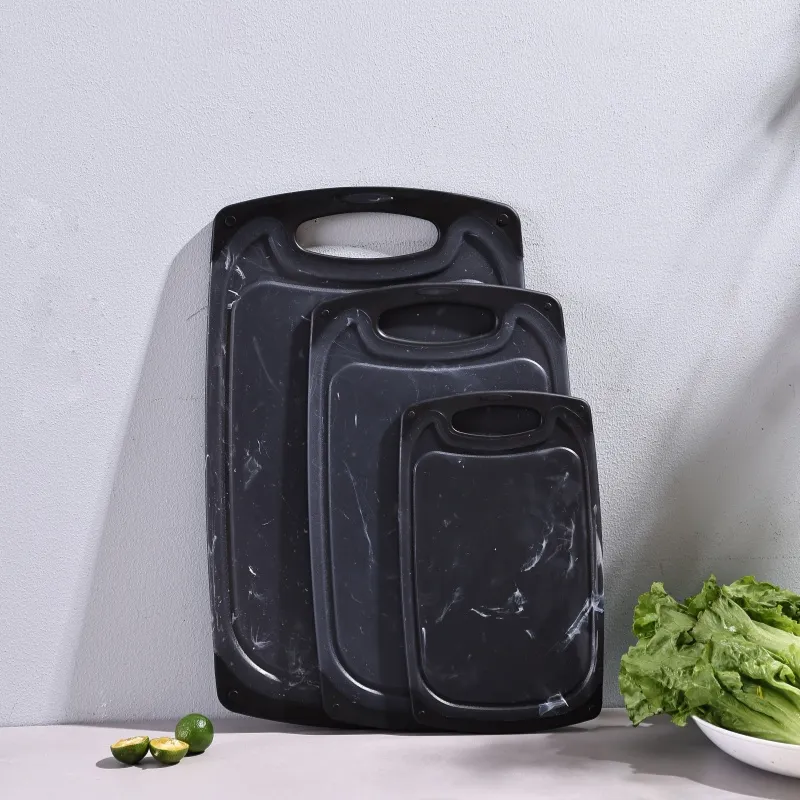
A Dark Face Ages Better
What 7 to 7.5 mm Will and Will Not Take
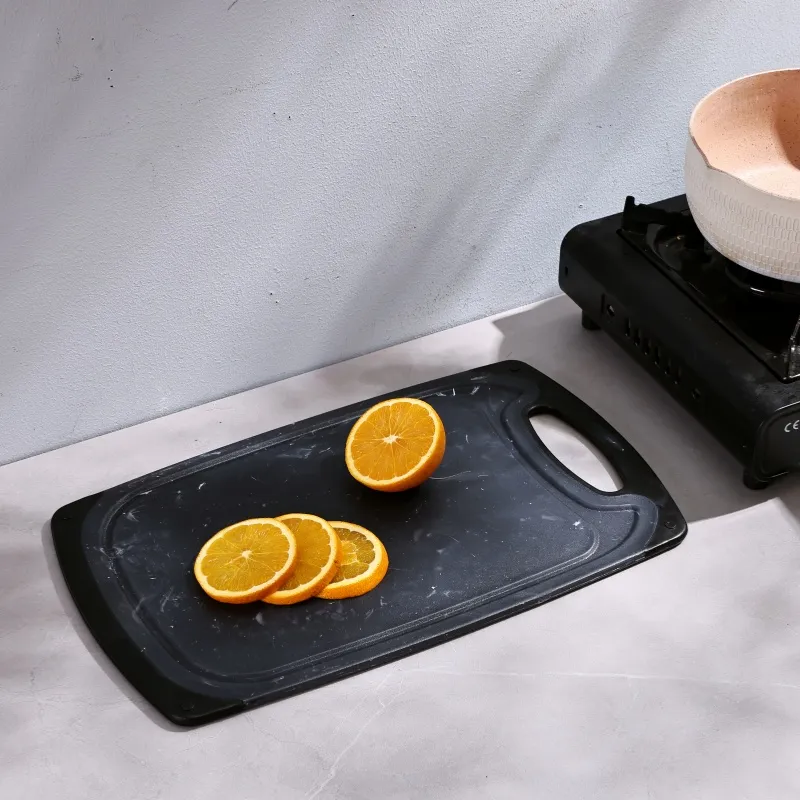
Specifications
Model 6615 Sizes 25 × 15 × 0.7 cm · 33 × 20 × 0.7 cm · 40 × 24.5 × 0.75 cm Section 7 mm / 7 mm / 7.5 mm Face Polypropylene with a moulded marble effect Rim Moulded TPE rim in a contrasting tone Groove Full perimeter on one face Second face Plain, flat Handle Oval cut-out, top edge Dishwasher Yes Certification FDA, LFGB Port Shanghai or Ningbo Payment T/T Who This Set Suits
Right for
Wrong for
Ordering and Customisation
Frequently Asked Questions
Is the marble pattern printed or moulded?
Does the groove run all the way round?
Can the board be used on both sides?
Will the black surface show knife marks?
Is 7.5 mm thick enough for carving a whole chicken?
Are the three boards the same colour?
Want this set in a different base tone?


