What to Know Before Buying a Durable Faux Marble Cutting Board
- Share
- Issue Time
- Nov 13,2025
Summary
Discover what to know before buying a faux marble cutting board including pros cons materials safety and care tips for stylish durable kitchen use
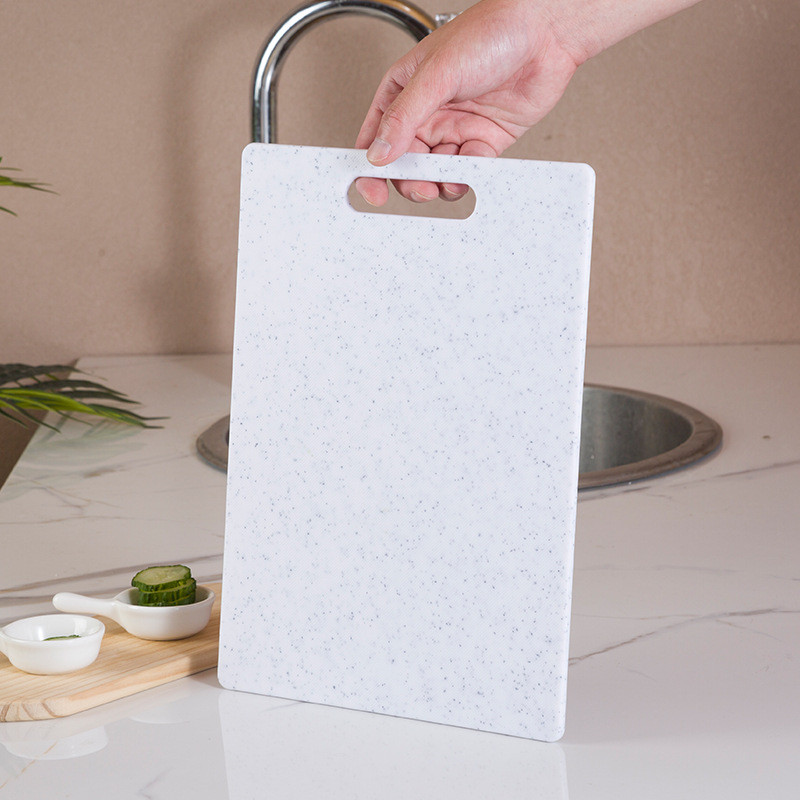
What "Faux Marble" Actually Means on a Cutting Board
Most of what is sold as a faux marble cutting board is a moulded plastic board with a decorative surface. The substrate is almost always polypropylene or high-density polyethylene, the colour comes from a food-grade masterbatch let down into the resin, and the veining is either etched into the tool or produced by running two coloured melts together. There is no stone, no printed film and no coating on a well-made one: the pattern is in the material, through its full thickness.
That distinction matters, because three other products get sold under the same words and only one of them belongs in a kitchen:
- Moulded PP or HDPE with a marble effect This is the real category. Non-porous, dishwasher tolerant, kind enough to an edge, and the pattern cannot wear off because it is not on the surface.
- Cast acrylic (PMMA) sheet Genuinely looks like stone and is often sold as a serving board or a sink caddy. It is hard and brittle: it chips at the corners, it marks under a knife, and it is the wrong material to cut on.
- Epoxy resin boards The hand-poured river-table style. Beautiful, and a poor cutting surface: epoxy is hard, it dulls an edge quickly, it yellows with UV, and most craft pours have no food-contact certification behind them.
Natural marble, for comparison, is heavy, cold, brittle at the edges, absorbs stains unless sealed, and is hard enough to roll a knife edge. It is a pastry surface and a cheese platter, not a chopping board. Almost nobody who wants a board to actually cut on should buy stone.
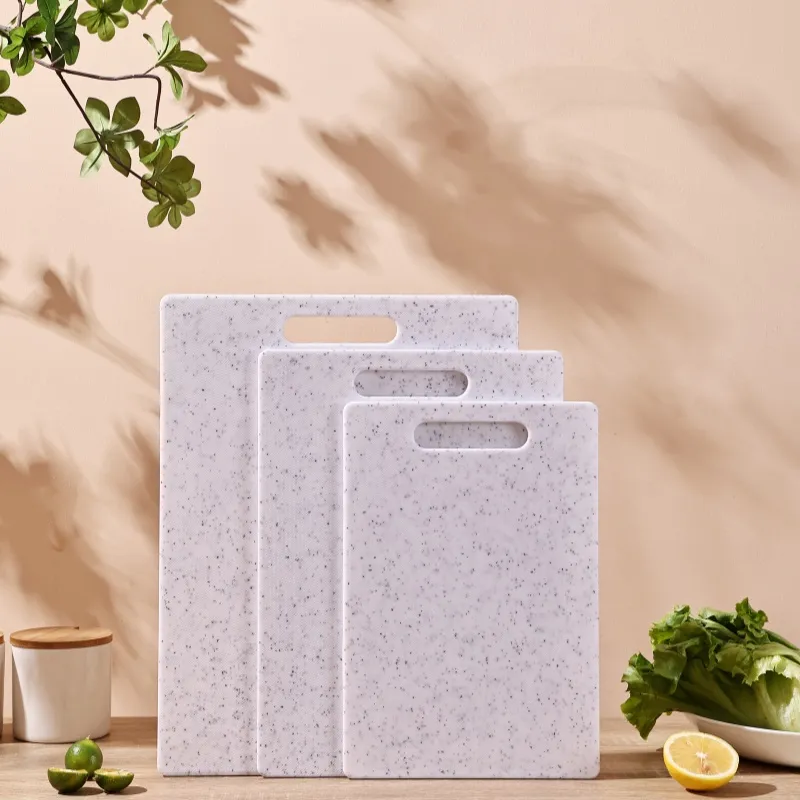
Why the Marble Look Sells
Set aside the styling for a moment and a marble-look plastic board has three genuine functional advantages, none of which depend on the pattern:
- It is non-porous. A moulded PP surface takes up no liquid, so it does not swell, does not hold odours and does not stain the way an open-grained wooden board can. Raw meat juices sit on the surface until you wash them off rather than soaking in.
- It is light. A marble-look board in the 30 x 20 cm range weighs a few hundred grams. Real stone of the same footprint is several kilos. If you lift the board in and out of a sink every day, this is the difference you notice.
- It is dimensionally stable and dishwasher tolerant. Injection-moulded PP at a sensible wall thickness holds its shape through a domestic dishwasher cycle. Wood does not, and neither does a thin acrylic sheet.
The styling is real value too, but be clear about what it is: a decor decision. It does not make the board cut better, and it does not make it last longer.
The Downsides, Stated Plainly
- It will show knife marks. Every polymer board does. On a glossy marble-look surface the marks catch the light and read as scratches, which is a cosmetic problem rather than a hygiene one as long as the grooves still come clean. A matte finish hides them far better than a high gloss.
- Heat is the real limit. PP softens well below the temperature of a pan taken off the hob. Never use the board as a trivet and never pour hot fat onto it. A warped board is almost always a heat story, not a wear story.
- It is still plastic in the hand. No moulding process makes polypropylene feel like stone. If you want the cold weight of marble, only marble gives you that.
- End of life is recyclable, not degradable. PP is a #5 recyclable stream in most markets, but it does not break down if it ends up in the ground. Buyers who care about this should ask for a recycled-content grade rather than a "biodegradable" claim, which no solid PP board can honestly make.
Five Checks Before You Pay for One
Everything that separates a board that still looks good in three years from one that looks tired in six months is invisible in a product photo. These five questions do the work:
- 1. Is the pattern through the material or on top of it? Ask directly. A pattern that is printed or laminated sits on the surface and wears through at the corners first. A pattern produced in the tool by two coloured melts cannot wear off, because there is nothing separate to wear. If a listing cannot answer this, assume print.
- 2. What is the substrate, exactly? "Marble" is not a material. PP, HDPE, acrylic and epoxy behave completely differently under a knife and against heat. A seller who will not name the polymer is a seller who has not asked their factory.
- 3. Is the finish gloss or matte? Gloss photographs beautifully and shows every mark. Matte photographs slightly flatter and still looks clean after a year of daily use. This is the single biggest driver of how long the board looks new.
- 4. Does it grip a wet counter? A rigid board on a wet quartz worktop slides. Look for a moulded textured back or corner pads. On a reversible board the grip has to be on both faces, or you have bought a single-sided board with a spare side.
- 5. Is the colourant food-grade? This is the one buyers skip. Ask for a declaration against FDA 21 CFR 177 or EU 10/2011 that covers the pigment, not just the base resin. A board can be "BPA free" and still use a colourant that was never assessed for food contact.
Marble effect that is in the material, not printed on it
Two coloured melts in one tool, so the veining runs through the full wall and cannot wear off at the corners. Send your size, colourway and target price and you get a costed offer rather than a catalogue download.
Ask for a quote and a sample →Factory direct · FDA and LFGB food-contact grade · OEM and ODM welcome
Size, Thickness and the Features Worth Paying For
Board sizes run from about 20 x 15 cm for a small prep board up to 45 x 30 cm for a full carving surface. The size most households actually use daily is around 30 x 20 cm, with a second smaller board for fruit and a larger one for meat if the kitchen has the room.
Thickness matters more than size. Under 8 mm a PP board will bow in a hot dishwasher and will flex under a knife. Around 10 mm is the practical floor for a board that gets washed often, and thicker than that is about weight and feel rather than durability.
Features that earn their place: a juice groove deep enough to hold liquid (4 to 5 mm), a hanging hole if the board lives on a hook, rounded corners if it is handled wet, and a non-slip back. Features that do not: printed measurements that wear off, decorative handles that create a thin section where the board will eventually crack.
Safety and Hygiene: What the Certificate Actually Covers
Food-contact compliance is not a single badge. The base resin has to comply, the colourant has to comply, and the finished article has to be tested as a whole. A supplier who can only produce a resin certificate has not finished the job.
The documents worth asking for are an FDA 21 CFR 177 declaration for the finished material, an LFGB or EU 10/2011 test report, and a migration test on the finished board rather than on pellets. ISO 9001 tells you about the factory's process control, not about the material, and should never be presented as a food-safety certificate on its own.
On antimicrobial claims, the question to ask is where the silver-ion compound sits. Compounded into the masterbatch, it is present through the wall and cannot be scrubbed away. Applied as a surface treatment, it is a coating that the first month of washing removes. Both get called "antibacterial"; only one survives.
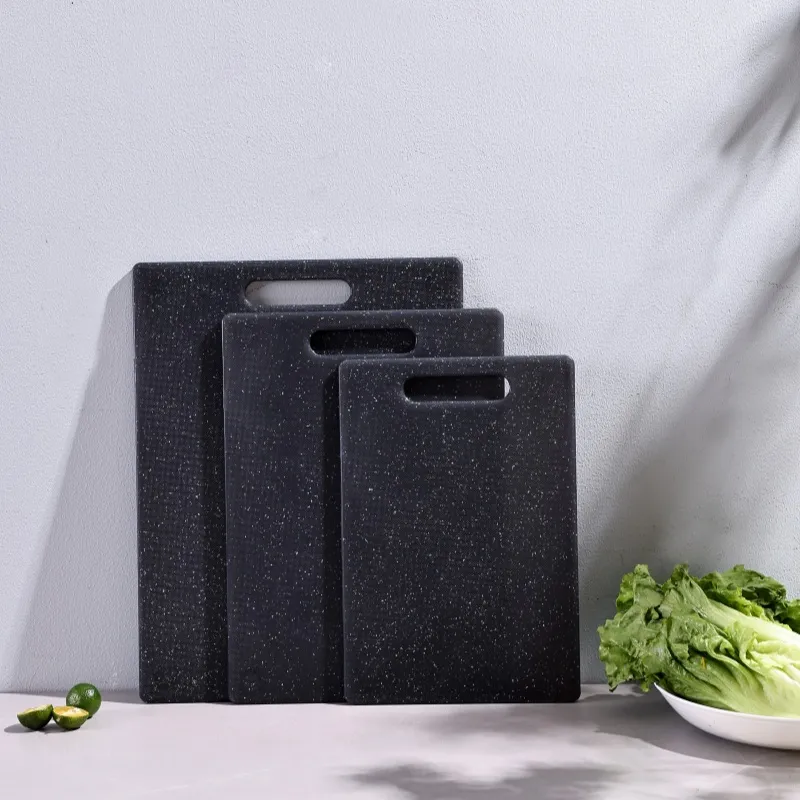
Care, and How Long It Actually Lasts
The care instructions for a marble-look PP board are short, and most premature failures come from ignoring just two of them.
- Dishwasher: yes, on a normal cycle, not on a hot wash with the board resting against a heating element. Where a board is not dishwasher safe it is usually because the manufacturer used a thin wall or a material that cannot take 70 degrees, not because plastic as a category cannot.
- Heat: no pans, no hot fat, no leaving it next to an open flame. This is the failure mode that is not repairable.
- Colour stains: turmeric, beetroot and coffee can tint a pale board. A paste of bicarbonate of soda and water, left for ten minutes, lifts most of it.
- Disinfection: a dilute bleach solution or a vinegar wipe after raw meat, then rinse and dry upright. Do not soak the board for hours; nothing is gained and the edges take in water at the seams.
A 10 mm food-grade PP board used daily and washed properly will typically give several years of service. What ends its life is not the pattern fading but the grooves getting deep enough that they stop coming clean. When a knife mark catches your fingernail and will not scrub out, the board is finished as a raw-meat surface, whatever it still looks like.
Frequently Asked Questions
Is a faux marble board safe for cutting raw meat?
Yes, if the surface is a non-porous food-contact polymer and the board is washed after use. A moulded PP board does not absorb juices. The risk is not the material but the grooves: once knife marks are deep enough to trap residue, no amount of washing reaches the bottom of them.
Can a marble-look board go in the dishwasher?
A moulded PP board at 10 mm can, on a normal cycle. Thin boards, acrylic sheets and epoxy pours cannot. The honest answer depends on the material and the wall thickness, so it is a question for the supplier rather than a category rule.
How does it compare with wood or bamboo?
Plastic is non-porous and easier to keep hygienic, and it tolerates a dishwasher. Wood and bamboo are softer on an edge and self-heal slightly under the knife, but they need oiling, cannot go in a dishwasher, and can crack if they dry unevenly. Neither is better in the abstract; they fail in different ways.
Will the marble pattern wear off?
Not if it was produced in the tool from two coloured melts, because the pattern runs through the material. It will if it was printed or laminated onto the surface. This is the single question worth asking before you buy, and a supplier who cannot answer it clearly is telling you something.
Is a marble-look board heavier than a plain plastic one?
No. Weight follows wall thickness and density, not colour. A marble-effect PP board weighs the same as a plain PP board of the same size and thickness. If one feels substantially heavier, it is thicker, not more "premium".
Marble-look boards we actually mould
Same factory, three ways to build the look, all of them moulded rather than printed.
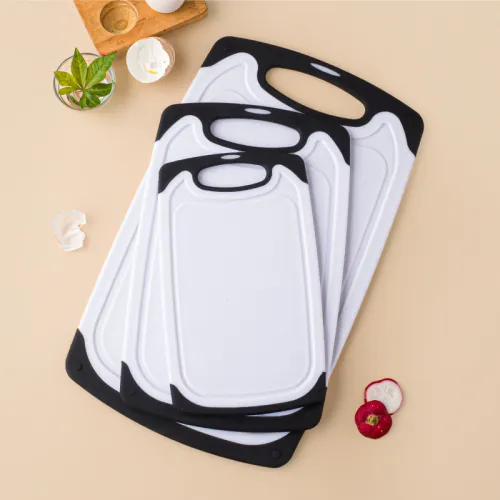 Three sizes, marble effectMarble-Effect Double-Sided Board SetPP body with a TPE edge, three sizes at 25 x 15, 33 x 20 and 40 x 24.5 cm. Embossed non-slip back, dishwasher safe.View specs →
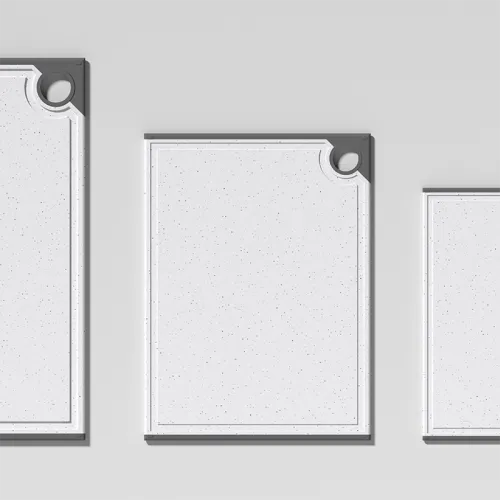 Three-piece setThree-Piece Cutting Board Set with Juice GroovesGraduated sizes so raw and produce never share a surface. Juice groove on each board, non-slip corner pads.View specs →
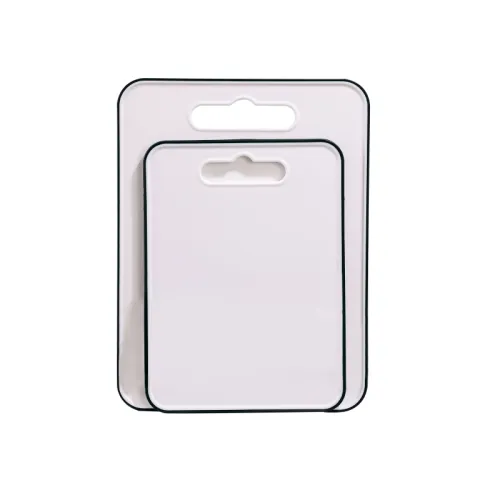 Soft cutting faceDouble-Sided Board with TPE Cutting FaceA soft TPE face that is kind to an edge, juice groove, embossed non-slip back. 31 x 23 cm and 38 x 29 cm, 1 cm thick.View specs →