Double-Sided vs Single-Sided Cutting Boards What to Look For Guide
- Share
- Issue Time
- Oct 31,2025
Summary
Discover the pros and cons of double-sided vs single-sided cutting boards and find the best features for durability hygiene and kitchen use.
Understanding the Basics Single-Sided vs Double-Sided Cutting Boards
When choosing a cutting board, one of the first questions is: single-sided or double-sided? Both types have their perks, and picking the right one depends on your kitchen habits and space.
What Is a Single-Sided Cutting Board
A single-sided cutting board has only one usable surface for chopping and cutting. The other side is usually flat and non-functional.
Pros:
- Stability: Often comes with non-slip feet or grips to keep the board steady.
- Simpler design: Easier to clean with no cracks or crevices on the back.
- Great for heavy-duty use: Usually thicker and more robust.
Cons:
- Less versatile: You can't flip it, so it may wear out faster on the front.
- Space: Takes up more room if you want a “clean” side for veggies and a “meat” side for hygiene.
What Is a Double-Sided Cutting Board
A double-sided or reversible cutting board offers two cutting surfaces—one on each side. Flip it over to switch tasks or freshen the surface.
Pros:
- Versatility: Use one side for raw meat, the other for veggies, helping prevent kitchen cross-contamination.
- Saves space: Two boards in one, great for small kitchens.
- Often has juice grooves: One or both sides can catch liquids to keep your countertop clean.
Cons:
- Can be less stable: Without non-slip features, it might slide more.
- Cleaning challenge: Food particles can get trapped around edges or grooves on both sides.
Quick Comparison Table
Swipe the table sideways for the full comparison.
| Feature | Single-Sided Board | Double-Sided Board |
|---|---|---|
| Usable Surfaces | One | Two (reversible) |
| Stability | Usually higher with grips | Varies, can be less stable |
| Space Saving | Needs separate boards | Saves space |
| Hygiene | Needs multiple boards for meat/veg | Better cross-contamination prevention |
| Durability | Often thicker & tougher | Can wear unevenly if not flipped |
| Cleaning | Simpler | More edges to clean |
Which type suits you? If you crave simplicity and heavy chopping, single-sided might be your go-to. If you juggle a lot in a small space and want versatility, reversible boards shine.
Ready to find the perfect match? Let’s break down the key features and nail down what your kitchen really needs!
Key Features to Look For Prioritizing Functionality and Safety
When shopping for a cutting board, whether double-sided or single-sided, prioritizing the right features ensures you get a board that lasts, protects your knives, and keeps your kitchen safe.
Material Matters Durability and Knife-Friendliness
- Wood (Maple, Ebony)
- Soft on knives, helps keep blades sharp
- Durable with proper care
- Bamboo is eco-friendly but harder than maple (may dull knives faster)
- Plastic
- Dishwasher-safe options available for easy cleaning
- Hardness varies more inside the plastic category than between plastic and wood. A thin rigid PP board is genuinely abrasive; a soft TPE-faced board is not, and it is the grade to ask for if you care about edge retention
- Ask whether the antimicrobial is compounded into the resin or applied as a surface treatment. Only the first survives being flipped, scrubbed and dishwashed
- Composite and Other Materials
- Offer durability and sometimes antimicrobial properties
- Usually knife-friendly and dishwasher-safe
Hygiene and Cross-Contamination Prevention
- Choose boards with juice grooves to catch liquids and reduce mess
- Consider non-slip features like rubber feet or textured backs for safety
- Using reversible chopping boards helps separate foods—like raw meat on one side, veggies on the other—cutting down cross-contamination risks
- For meat cutting, opt for hygienic meat cutting surfaces like plastic or antimicrobial boards
Design Elements for Everyday Use
- Size matters: bigger boards handle more prep but need more storage space
- Weight: lighter boards are easier to clean and move, heavier ones stay put
- Some double-sided boards offer different textures or grooves on each side to suit various tasks
- Look for rounded edges and easy-to-grip handles for better control
Swipe the table sideways for the full comparison.
| Feature | What to Look For | Why It Matters |
|---|---|---|
| Material | Maple, bamboo, antimicrobial plastic | Durability, knife safety, hygiene |
| Juice Groove | Present | Prevents spills, keeps counter clean |
| Non-Slip | Rubber feet, textured underside | Safety—prevents slipping |
| Reversible Surfaces | Double-sided boards | Separate food types, avoid cross-contamination |
| Size and Weight | Fits your kitchen space and workflow | Convenience and stability |
For more on choosing the right materials, check out our guide on plastic cutting board trends for safety and efficiency.
Six Things to Check Before You Trust a Reversible Board
Most buying advice stops at "make sure it has juice grooves." Grooves are the easy part. These six details decide whether a double-sided board is still flat and still tight eighteen months in, and all six are set by the tool and the moulding parameters rather than by anything printed on the packaging.
- 1. Are both faces the same thickness? A difference of a millimetre between the two sides is enough to make the board rock when you flip it. Take a caliper to it, or set it on a flat counter and press each corner in turn. A board that is only stable on one face has quietly become a single-sided board.
- 2. Is it one moulding or two pieces glued together? Look along the edge. A bond line, a seam, or a colour change running in a straight stripe around the perimeter means two halves were joined. Glue lines take in water at the dishwasher and are the first place a laminated board fails. A single-shot moulding has no interface to fail.
- 3. Was the grip edge moulded on, or glued on afterwards? A soft TPE strip applied after the fact lifts at the corners within a year, and the gap under a lifted strip is the hardest place on the board to clean. When the TPE is injected into the same tool, it bonds at the interface and there is no gap to begin with.
- 4. How deep is the juice groove, really? Under 3 mm and it will not hold the liquid off a resting chicken. Over 6 mm and the channel is too narrow to scrub properly at the bottom. The useful range is roughly 4 to 5 mm wide with a rounded floor, deep enough to catch, open enough to clean.
- 5. Does it grip on both faces? The most common shortcut on a reversible board is grip on one side only: feet or a textured back on the meat face, bare plastic on the other. Whichever method is used, embossed pattern or moulded feet, it has to be on both sides, or the board is only half finished.
- 6. Can you tell the two faces apart at a glance? Cross-contamination prevention on a reversible board depends on a rule you can follow when you are tired. Two visibly different colours work. Two identical grey faces rely on memory, and memory is not a hygiene system.
None of these six shows up in a product photo, which is exactly why they are worth asking about. A board that passes all six is a different object from one that passes two, even when both look the same online.
Pros and Cons in Real Kitchens Which Wins for Your Cooking Style
Choosing between a double-sided vs single cutting board depends a lot on your kitchen habits and available space.
Best for Small Spaces and Quick Meals Double-Sided Boards
Double-sided cutting boards are perfect if you're tight on counter room or like to prep quickly. You can use one side for veggies and flip it for meat or bread, helping prevent cross-contamination without juggling multiple boards. Their reversible design also means less storage hassle, which works great in compact kitchens.
Best for Heavy-Duty Tasks Single-Sided Boards
If you often handle big chopping jobs or heavy-duty kitchen work, single-sided cutting boards usually hold up better. Many single-sided boards are thicker and designed with one robust surface, making them excellent for butcher tasks or high-volume cooking. They often come with juice grooves to keep mess contained during heavy slicing or carving.
Cost vs Value Budget Breakdown
When it comes to buying, single-sided boards can sometimes cost less upfront. However, double-sided boards offer more versatility, potentially giving you more value in everyday use. Think about whether you want to invest in a board that serves multiple purposes or a specialized board for heavy chopping. Also consider what the price is actually buying. On a reversible board the cost sits in the tool: two faces on one shot, a TPE edge moulded in, a groove cut to depth. Two boards that look identical in a photo can differ by a factor of two in tooling cost, and the difference shows up in year two rather than on day one.
Maintenance and Care Extending the Life of Your Board
Taking care of your cutting board is key to making it last longer and staying safe to use. Whether you have a single-sided or double-sided board, a good cleaning routine and proper upkeep will protect it from cracks, stains, and bacteria buildup.
Cleaning Routines by Type
- Wood Boards: Hand wash with warm, soapy water right after use. Avoid soaking or dishwasher cleaning, which can warp or split the wood. Occasionally, treat with mineral oil or a food-safe conditioner to keep the wood from drying out.
- Plastic and Composite Boards: These can often be rinsed in the dishwasher. If not dishwasher-safe, scrub with hot, soapy water and sanitize with a diluted bleach or vinegar solution to reduce microbes. Look into recyclable plastic cutting boards for eco-friendly options.
- Granite or Stone Boards: Clean with mild soap and water; avoid acidic cleaners that might damage the surface. Dry thoroughly to prevent moisture buildup.
When to Replace Warning Signs
Watch for these signs that it’s time for a new cutting board:
- Deep grooves or cracks that trap bacteria and can't be cleaned thoroughly.
- Warping or splitting that makes the board uneven or unstable.
- Persistent odors or stains, especially on plastic boards.
- Excessive knife marks that dull blades quickly.
If you notice any of these, it's safer to replace your board than risk kitchen cross-contamination. Regular maintenance paired with mindful inspection helps keep your cutting surface hygienic and effective.
For more on keeping plastic cutting boards clean and safe, check out this guide on sanitizing plastic cutting boards.
Need a double-sided board that survives being flipped?
Both faces moulded in one shot, the same thickness top and bottom, the grip edge bonded in the tool rather than glued on afterwards. Send your size, colour split and target price and you get a costed offer rather than a catalogue download.
Ask for a quote and a sample →Factory direct · FDA and LFGB food-contact grade · OEM and ODM welcome
How Chopaid Actually Builds a Double-Sided Board
We should be straight about what we are: a plastic board factory in Taizhou, Zhejiang. We do not make maple boards and we do not make end-grain boards, so nothing in this section is an argument that you should buy plastic instead of wood. Wood is the better surface for some kitchens, and that is a decision only you can make.
What we can speak to with authority is what happens inside the tool, because that is where a reversible board is won or lost. Four things we control:
- Both faces from one shot. The top and bottom surfaces are formed in the same closing of the mould, so they are the same thickness, the same density and the same flatness. There is no second operation to introduce a warp, and nothing that can delaminate later.
- Colour that runs through the part. Where a customer wants the two faces in different colours, both are injected into the same closed tool and bond at the interface. The colour goes all the way through rather than sitting on the surface, so it cannot wear off at the corners the way a print or a coating does, and the fresh face stays identifiable after years of scrubbing.
- The TPE edge moulded in, not stuck on. The grip strip is injected against the board body in the same cycle, so it is a bond rather than an adhesive joint. That is why there is no lifted corner to clean under.
- Antimicrobial in the masterbatch. The silver-ion compound is let down into the resin before the part is moulded, so it is present through the full wall thickness. A surface spray is a coating; a masterbatch additive is the material.
Behind that sits the plant: 11 Haitian injection machines with a maximum clamping force of 530 tonnes, around 200 tonnes of food-grade resin a month, and more than 100 board designs in current production, with FDA, LFGB and ISO 9001 on file. That scale is the reason a custom size, a custom colour split and a custom groove layout are a tooling conversation rather than a rejection.
Which Version Suits Which Kitchen
Reversible is not one product. It is a shape that gets built four different ways depending on what the second face has to do.
- If you want one soft face and one firm face Take a board with a TPE cutting surface on one side and a firmer PP body behind it. The soft face is the one for protein and fine knife work; the firm face takes heavy chopping and the cleaver. This is the configuration that answers the "plastic dulls my knives" objection, because the face that touches the edge is not hard plastic.
- If raw meat and produce share the same drawer Take a matched set in two or three sizes rather than one reversible board. Dedicating a size to a task works as well as colour coding, and it also stops you cutting a whole chicken on the small board.
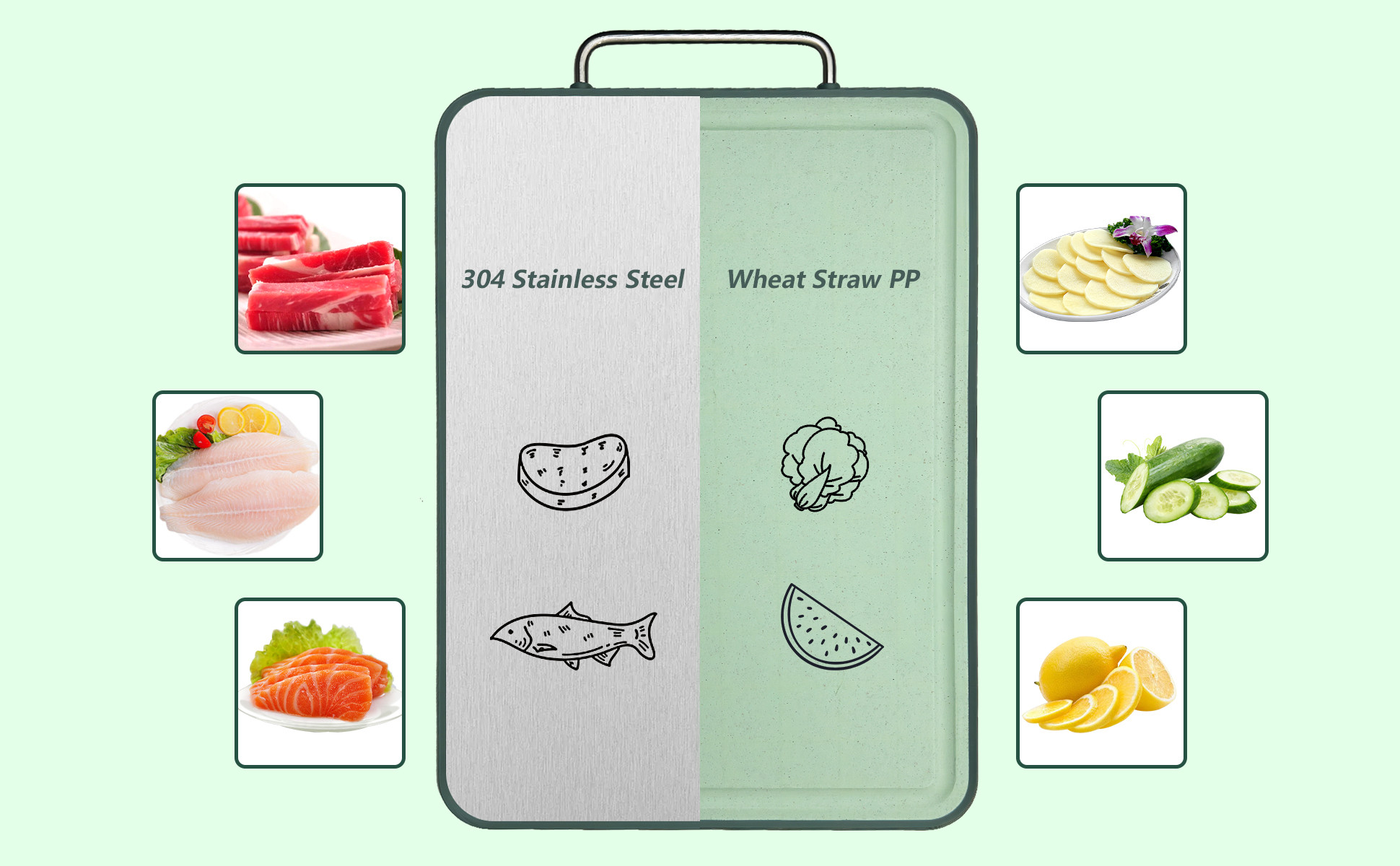
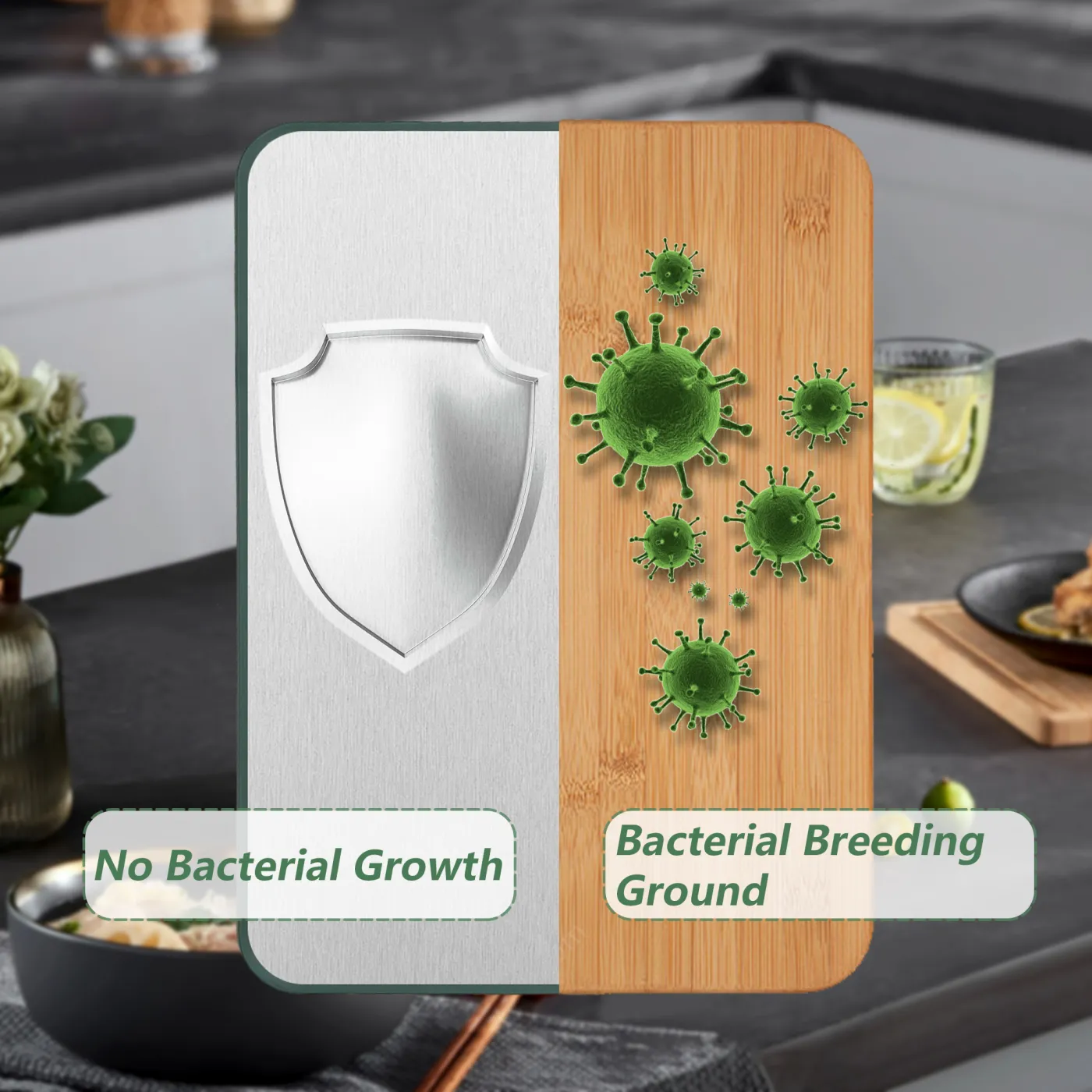
- If the second face needs to be genuinely non-porous Take a steel-and-polymer board: SUS 304 on one face for raw protein, wheat-straw PP on the other for produce. A different material on each side, and a steel face that can be sanitised in a way no polymer face can.
- If you chop hard and often, and flip rarely A thick single-sided board is honestly the better tool. It is heavier, it stays put without feet, and there is no second face to keep clean. Reversible is a space and hygiene solution, not a durability upgrade. If neither space nor cross-contamination is your problem, buy the thicker board.
Reader Poll Quiz Find Your Match
Still not sure which cutting board is right for you? Take a quick poll:
-
Do you prepare different food types daily and want to avoid cross-contamination?
- Then a reversible double-sided cutting board is your best bet.
-
Do you need a hefty board designed for tough chopping and long-term use?
- A thick single-sided board works best: three centimetres of solid material rather than one, so there is mass under the cleaver and no second face to keep clean.
-
Are you short on space and need something versatile that’s easy to store?
- Double-sided, slim boards are perfect.
-
Concerned about maintenance and hygiene?
- Look for a board that is dishwasher-safe, and check that the antimicrobial is compounded into the resin rather than sprayed on. Bamboo is often described as naturally antimicrobial; in practice it is a porous grass that takes up water and needs oiling, so treat that claim as marketing rather than hygiene.
Answer those four and you will know which of the four configurations above is yours. If you are still torn, the tiebreaker is the sixth check: if you cannot tell the two faces apart at a glance, no amount of care will keep raw and cooked separate.
Three ways to build a reversible board
Same factory, three different answers to the same question: which face does what.
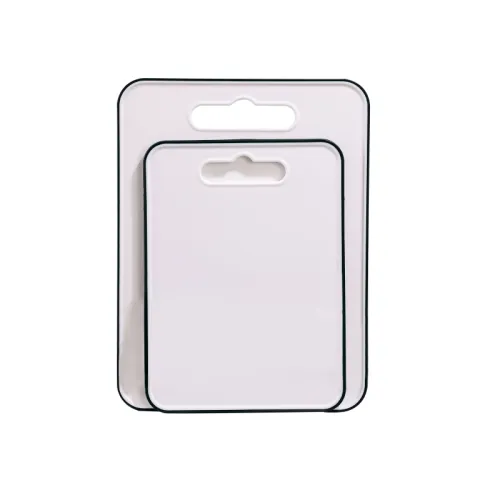 Soft cutting faceDouble-Sided Board with TPE Cutting FaceA soft TPE face that is kind to an edge, juice groove, embossed non-slip back. 31 x 23 cm and 38 x 29 cm, 1 cm thick, dishwasher safe.View specs →
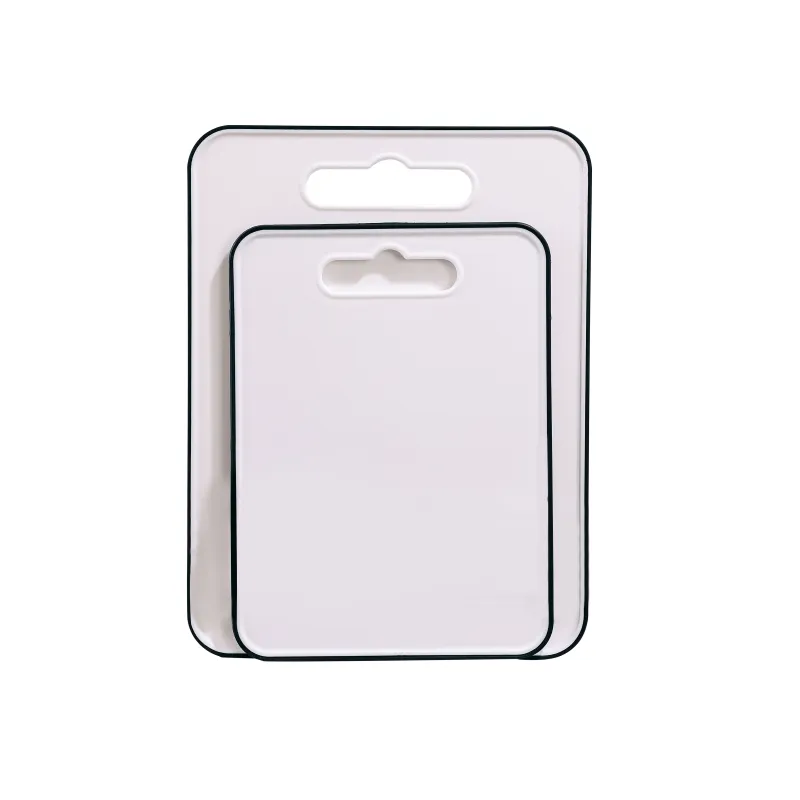
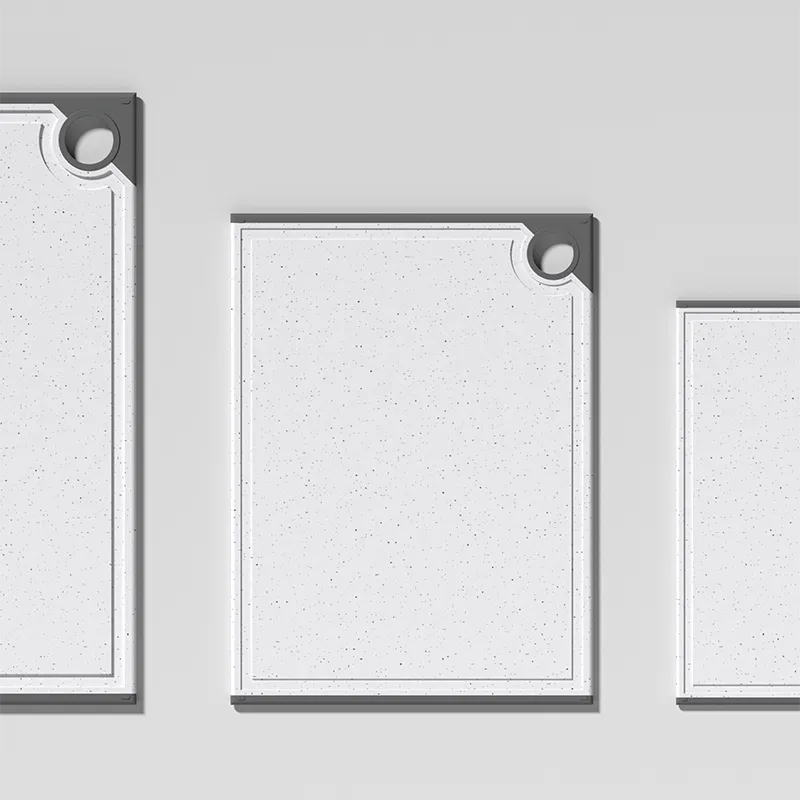
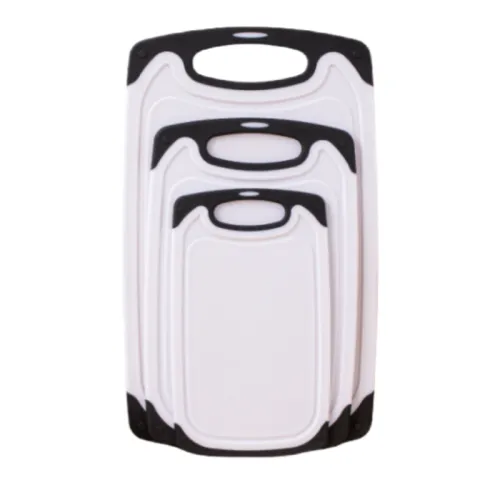 Three sizes, marble greyMarble-Grey Double-Sided Board SetPP body with a TPE edge, three sizes at 25 x 15, 33 x 20 and 40 x 24.5 cm. Embossed non-slip back, dishwasher safe.View specs →
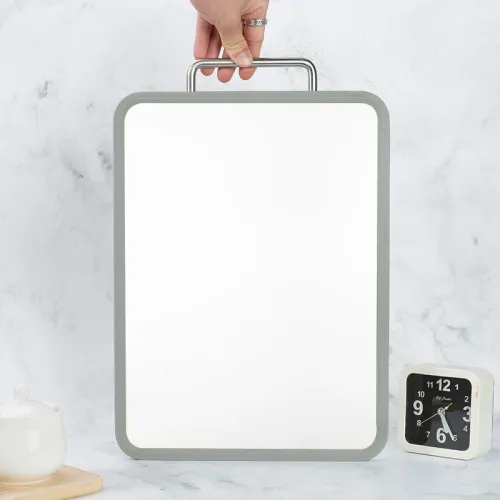 Steel and polymerSUS 304 / Wheat Straw Double-Sided BoardSUS 304 on one face for raw protein, wheat-straw PP on the other for produce. 40 x 28 x 1.1 cm, embossed non-slip back, silver-ion antibacterial.View specs →