Best Titanium Cutting Boards 2025 — Reviews & Top Picks
- Share
- Issue Time
- Sep 21,2025
Summary
In 2025, titanium cutting boards are an emerging premium option for cooks who want exceptional hygiene, durability and a modern look

Search for a titanium cutting board and you will find a dozen ranked lists, most of them naming brands you cannot buy in a shop and reviewing boards nobody has held. This is not one of those. We make boards, including a titanium-faced one, and the useful thing we can tell you is what the material actually does and how to tell one grade of it from another before you pay for it.
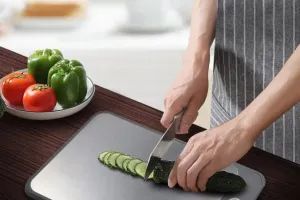
Three Different Products Are Sold Under the Same Name
"Titanium cutting board" covers three things that behave nothing alike, and the price gap between them is the first clue:
- A solid titanium plate. Three to five millimetres of titanium, edge to edge. Genuinely inert, genuinely expensive, genuinely hard on a knife, and heavy enough that you notice it every time you lift it out of the sink.
- A titanium-faced composite. A titanium sheet bonded to a polymer or wood backer. The face does the hygiene work, the backer gives the board thickness, grip and a little give. This is what most of the boards on the market actually are, and it is the configuration we build.
- A titanium-coloured board. Aluminium or steel with a grey finish that photographs like titanium. It is not titanium, it does not behave like titanium, and if the listing is under a certain price this is almost certainly what is in the box.
How to tell them apart in ten seconds: look at the edge. A composite shows a visible layer line where the titanium sheet ends and the backer begins. A solid plate is one continuous material. A coated board shows a painted edge that will eventually chip, and the weight gives it away too, because aluminium is about half the density of titanium.
The Trade-off Nobody Puts in the Marketing Copy
Titanium is hard. Commercial pure titanium runs around 150 to 200 on the Vickers scale; type 304 stainless sits close behind at roughly 200. A kitchen knife in the common 56 to 61 HRC range works out to somewhere in the 600 to 700 HV region, so the blade is still harder than the board. But edge retention is not only about which material is harder: a hard, unyielding surface concentrates the whole force of the cut into a very small contact area and rolls the apex of the edge, cycle after cycle.
This is why every honest answer to "does a metal board dull my knife" is yes. It is physics, not a manufacturing defect, and no surface finish removes it. What a finish can do is reduce it: a bead-blasted or brushed face presents thousands of tiny contact points instead of one continuous mirror, which spreads the load and cuts the abrasion noticeably compared with a polished surface. If you are choosing between two titanium boards and one of them is mirror-polished, the matte one will be kinder to your knives.
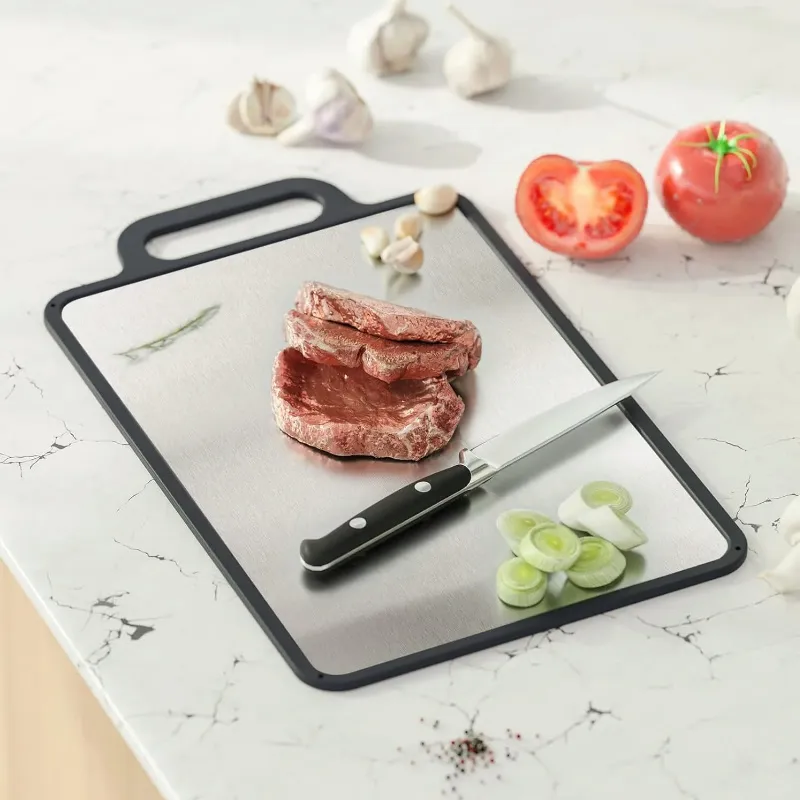
The practical consequence is a division of labour. Use the metal face for what metal is good at, which is raw protein, fish, and anything that stains or smells. Do the fine knife work, the herbs and the garnishes, on a wooden or a soft plastic face. A board that tries to be the only surface in the kitchen will either dull your knives or bore you.
Where Titanium Actually Earns Its Price
- It does not corrode, and acid does not touch it. Lemon juice sits at around pH 2 and vinegar at pH 3. A 304 stainless board will develop pits at the grain boundaries after enough contact with salt and acid; titanium does not, which is why it is used for chemical process equipment and for medical implants.
- It takes no smell and no colour. Garlic, fish, ginger and turmeric leave nothing behind on a titanium face because there is nothing for them to soak into. A pale plastic board will hold a turmeric stain; a wooden board will hold the smell of fish.
- There is no coating to fail. The surface is the material. There is no film, no lacquer, no print layer and no antimicrobial topcoat that the first months of washing can strip off.
- It tolerates real heat. Boiling water, a dishwasher, a hot pan set down for a moment. Titanium's melting point is above 1,600 degrees, and it does not soften the way polypropylene does near 100.
- It is light for a metal. Density is 4.51 g/cm³ against 7.93 for stainless, so a titanium board of the same dimensions is roughly 43 per cent lighter. On a 40 cm board that is the difference between lifting it with two fingers and lifting it with two hands.
And Where It Loses
- It dulls knives. Covered above, and it is the main reason a metal board should never be your only board.
- It is slippery. A flat metal plate on a wet worktop moves. Any metal board needs a textured or rubberised back, and if it does not have one, it is not finished.
- Thin plate rings. A 3 mm titanium sheet on a hard counter resonates under a knife in a way that is genuinely unpleasant at six in the morning. Thickness and a polymer backer both damp it.
- Marks show. Titanium develops a hairline patina of fine scratches. It is cosmetic, it does not affect hygiene, and some people like it. Mirror-polished titanium looks worse, faster.
Titanium Against the Four Other Boards
Swipe the table sideways for the full comparison.
| Board | Hygiene | Effect on an edge | Weight | Heat and acid | Best for |
|---|---|---|---|---|---|
| Titanium | Excellent — the surface is the metal, no pores and no coating | Poor. Among the hardest surfaces you can cut on | Medium — about 43% lighter than steel for the same volume | Excellent. Lemon, vinegar and tomato do not touch it | Raw protein and fish where smell and staining matter |
| SUS 304 stainless | Excellent | Poor, close to titanium | Heavy — roughly twice the weight of titanium | Good, but acidic and salty contact can pit it over time | The same jobs, at a lower material cost |
| Hardwood (maple) | Fair — open grain takes up liquid unless oiled | Excellent, the kindest surface for a knife | Heavy | Fair — warps and splits with heat and soaking | Daily vegetable and bread prep |
| Bamboo | Fair — dense but still porous | Moderate. The silica in bamboo is harder on an edge than maple | Medium | Poor — prone to cracking when it dries unevenly | Budget boards and lightweight prep |
| PP / PE plastic | Excellent — non-porous and dishwasher tolerant | Good, and the best of the lot if the face is a soft TPE | Light | Fair — softens near 100 °C, so no hot pans | High-frequency daily chopping |
Titanium-faced boards, made on our own tooling
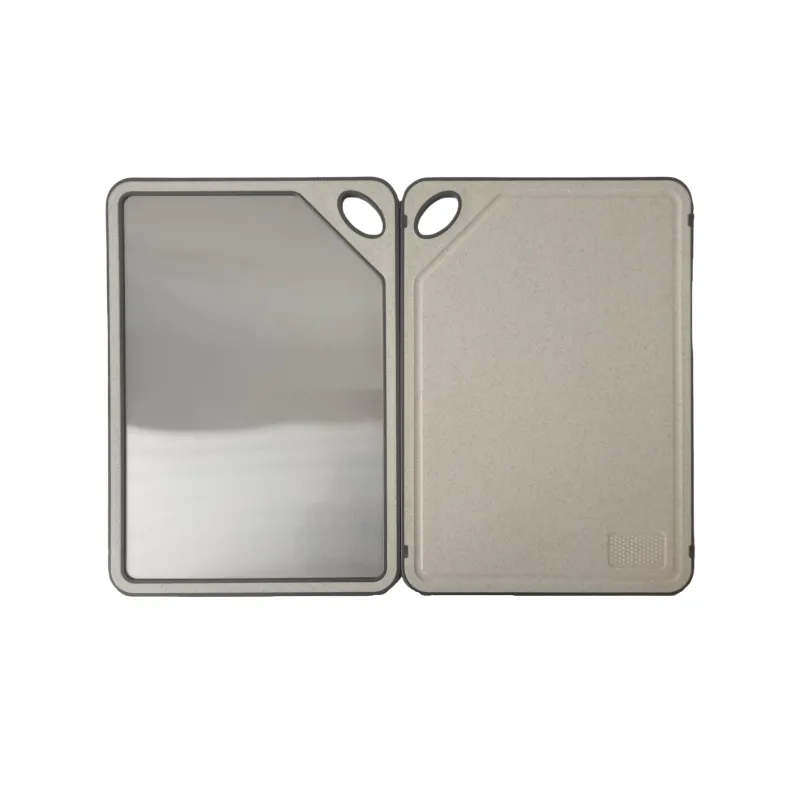
A titanium face bonded to a wheat-straw PP backer, 40 x 28 x 1.1 cm, embossed non-slip back and silver-ion compound in the polymer. Send your size, face material and target price and you get a costed offer rather than a catalogue download.
Ask for a quote and a sample →Factory direct · FDA and LFGB food-contact grade · OEM and ODM welcome
What to Check Before You Buy One
- 1. Solid, faced, or coloured? Look at the edge, not the face. Layer line means composite; continuous means solid; a chipped or painted edge means neither.
- 2. How thick is the titanium itself? On a composite the sheet is usually between 0.4 and 1 mm. Ask, because a 0.4 mm facing and a 1 mm plate are different products at different prices, and the photos look identical.
- 3. What is on the back? A solid titanium board needs moulded feet. A composite needs an embossed or rubberised back. Bare metal on both sides means the board will skate.
- 4. Is the face polished or textured? Polished looks better in a photograph and is worse in use, both for knife wear and for visible scratches. Brushed or blasted is the practical choice.
- 5. Have the edges been broken? A rolled titanium edge is fine; a sheared edge is sharp enough to cut a hand when you wash it. Run a thumb along it before you buy, or ask the supplier whether the edge is deburred and rounded.
The Composite Answer, and Why We Build It That Way
The board we make is deliberately not a solid plate. It is a titanium face on a wheat-straw polypropylene backer, 40 x 28 x 1.1 cm, with an embossed non-slip back and a silver-ion antibacterial compound in the polymer. The reasoning is simple: each material does the job it is good at. The titanium face handles raw protein, fish and anything acidic, takes no odour, and can be washed at any temperature. The polymer backer supplies the thickness that stops the board ringing, the grip that stops it sliding, the weight reduction that makes it liftable, and a second working surface that is kind to a knife.
That is the honest version of what a metal board can be. Not a single heroic surface, but two faces with different jobs on one board.
Care
- Washing: warm water and washing-up liquid, or a dishwasher cycle. Titanium is unaffected; the polymer back is what you are protecting, so keep it off the heating element.
- No steel wool. An abrasive pad will leave visible scratch patterns on titanium. A soft sponge is enough, because nothing sticks to the surface in the first place.
- Water marks: a paste of bicarbonate of soda lifts dried-on mineral deposits and protein films without scratching.
- Heat discolouration: titanium takes on a faint straw or blue tint when it gets very hot. This is a stable oxide layer, not rust and not a defect, and it does not affect food safety.
Frequently Asked Questions
Is titanium safe for food contact?
Yes. Titanium is biologically inert and is used for surgical implants, which is a stricter standard than food contact. It does not leach, does not react with food acids, and needs no coating to be safe.
Will a titanium board rust?
No. Titanium forms a stable passive oxide layer within moments of being exposed to air, and that layer is what makes it corrosion resistant. It is not a coating that can wear through, which is the difference between titanium and a plated or painted metal.
Does it dull knives faster than plastic?
Yes, considerably. Plastic, and especially a soft TPE-faced plastic, gives under the edge; titanium does not. If edge retention is your priority, a metal board is the wrong choice for your main prep surface, whatever the surface finish.
Can it go in the dishwasher?
The titanium can, without limit. Whether the whole board can depends on the backer. A polypropylene-backed composite is fine on a normal cycle; a wooden-backed one is not. Check the material of the side you are not looking at.
Why is titanium more expensive than stainless steel?
Extraction and processing. Titanium requires the Kroll process, which is energy intensive and batch based, and machining it is slower than machining steel. The material cost per kilo is several times that of 304 stainless, and that difference lands in the retail price of a solid plate.
Metal-faced boards we actually mould
Three answers to the same question, all of them made in the same plant.
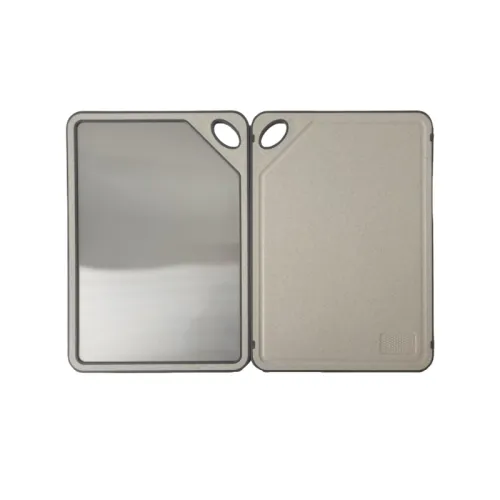 Titanium faceTitanium and Wheat Straw Double-Sided BoardTitanium on one face for raw protein, wheat-straw PP on the other. 40 x 28 x 1.1 cm, embossed non-slip back, silver-ion antibacterial.View specs →
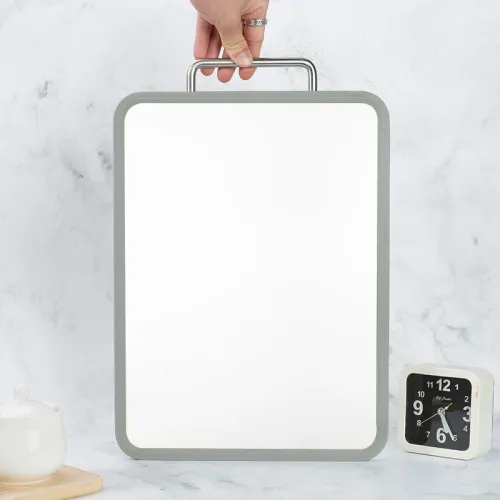 SUS 304 faceSUS 304 / Wheat Straw Double-Sided BoardStainless on one face, wheat-straw PP on the other. The same configuration at a lower material cost, 40 x 28 x 1.1 cm.View specs →
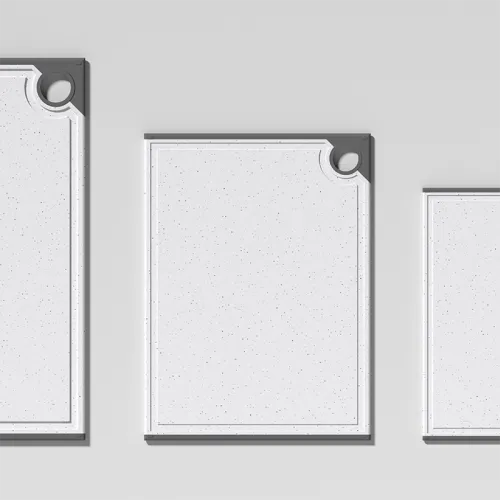 Three-piece setThree-Piece Cutting Board Set with Juice GroovesGraduated sizes so raw and produce never share a surface. Juice groove on each board, non-slip corner pads.View specs →